Rebellion and War in Heaven
Paradise LostRebellion and War in Heaven is the decisive prehistory of Paradise Lost. It begins when Satan, once a foremost Arch-Angel, responds with envy and pride to God’s declaration that the Son of God is Messiah and rightful King. What first appears as an argument about liberty, equality, and political authority becomes armed revolt: Satan gathers a third of the heavenly host, challenges the divine order, and is finally defeated by the Son of God, who drives the rebels from Heaven into Hell. The episode establishes the poem’s central distinction between genuine freedom and self-enslaving pride, while its consequences reach forward into Satan’s attempt to seduce Adam and Eve.
Revelation and Background
The event is narrated as a revelation within the larger narrative. Adam asks Raphael to explain the earlier conflict among the heavenly powers, and Raphael warns that the subject concerns invisible spiritual actions that must be rendered through bodily images intelligible to human sense. His account therefore supplies the hidden history behind the present danger: Satan, formerly known by his heavenly name and ranked among the greatest Arch-Angels, cannot endure the honor given to the Son of God. God proclaims the Son begotten, anointed, and appointed Head of Heaven, commanding every heavenly knee to bend before him. The decree also defines disobedience as a rupture of union with God, followed by expulsion into utter darkness without end.
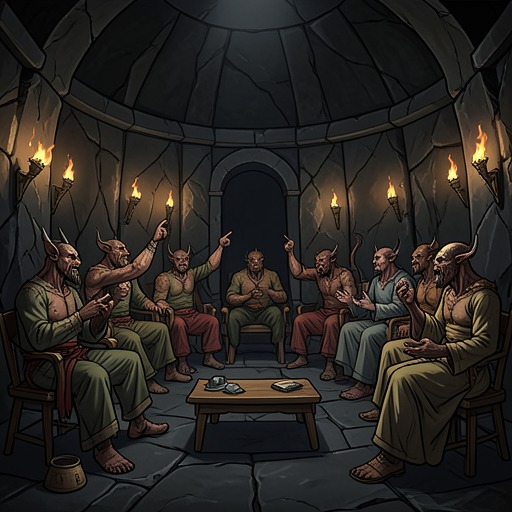
Satan interprets this decree as an injury to his own status. During the night, when the other angels have retired to rest, he secretly awakens his closest associate and presents the new command as a threat to their ancient dignity. He orders the powers under his banners to move toward the North, claiming that the march is intended to prepare a reception for Messiah. The language is deliberately ambiguous: Satan disguises rebellion as obedience and uses a supposed official summons to gather his followers. Once assembled on the Mountain of Congregation, however, he discloses the real purpose of the meeting. He argues that beings who are free and equal should not be compelled to kneel before a new monarch, especially one whose authority, in his presentation, eclipses their own.
The Rebellion and Its Ideology
Satan’s political rhetoric joins the vocabulary of liberty to an ambition for supremacy. He maintains that heavenly orders and degrees need not contradict freedom, but he rejects any authority that claims to rule those who are supposedly its equals. His objection is not merely personal resentment; it is framed as a defense of collective independence against imposed law, adoration, and servile submission. In this sense, the rebellion presents itself as resistance to monarchy and as an appeal to the dignity of self-government.
Abdiel exposes the contradiction within that appeal. He insists that God’s decree is just because the Son of God is not an arbitrary superior but the one through whom God created the heavenly powers. The Son’s reign does not erase their glory; it unites and heightens it under a rightful head. Abdiel further distinguishes honorable service from servitude: to serve God, or nature’s worthiest ruler, is fitting obedience, whereas to serve an inferior rebel is genuine enslavement. Satan’s language of freedom thus conceals a transfer of allegiance from divine order to Satan’s own authority. His followers reject Abdiel’s warning, and Satan answers by claiming that the angels are self-begotten and self-raised, a denial of their created dependence that turns political dissent into metaphysical rebellion.
Abdiel stands alone among the assembled rebels. Satan and the multitude treat his resistance as singular and rash, but he remains unmoved, unseduced, and unafraid. He leaves the rebel encampment through hostile scorn and turns his back on the towers destined for destruction. His isolation gives the episode one of its sharpest contrasts: numerical strength belongs to rebellion, while fidelity belongs to the single dissenter. The poem therefore refuses to measure truth by majority consent.
The Heavenly Battle
After Abdiel’s departure, Heaven’s forces prepare for war. Michael and Gabriel lead the loyal angels, who meet Satan’s innumerable host across the heavenly plain. The first combat is a vast collision of armies: chariots and flaming weapons cross the air, fiery darts form volleys, and millions of angels fight on ground and in flight. The battle remains balanced for a long time because each combatant possesses immense strength, yet the Eternal King limits the conflict so that the created powers cannot destroy Heaven itself.
The struggle changes when Abdiel confronts Satan directly. Abdiel argues that Satan still mistakes rebellion for freedom and declares that service to the one whom God ordains is not bondage. Satan replies that those who serve God are merely ministers trained for feast and song, while his own followers supposedly defend liberty. Abdiel answers that Satan is not free but enthralled to himself. He then strikes Satan’s crest with such force that Satan recoils ten enormous paces and falls to one knee, using his spear to keep his massive body upright. The blow astonishes the rebel leaders and brings joy to the faithful host, while Michael’s trumpet summons the wider battle.
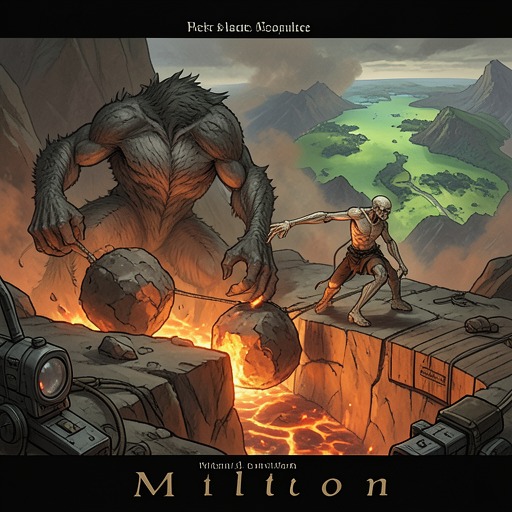
The fighting grows beyond ordinary warfare. The angels tear entire hills from their foundations, carrying rocks, woods, and waters as weapons. Mountains are hurled against mountains; rebel legions are crushed beneath the weight of the landscape, and their armor worsens their confinement. The scene turns Heaven into a world of elemental upheaval, but the Eternal Father has foreseen the disorder and permits it within limits. War is allowed to reveal the Son’s appointed authority, not to settle the question through an independent contest of equal powers.
The Son of God’s Victory
After two days of battle, the Eternal Father declares that the third day belongs to the Son of God. The prolonged conflict has exhausted what war can accomplish, and only the Son can end it. The Father therefore gives him the chariot, bow, thunder, and sword of divine power, charging him to drive the rebels beyond Heaven’s bounds. The Son accepts this authority as an act of filial obedience and identifies his own glory with the fulfillment of the Father’s will.
The Son of God advances in a chariot drawn by four living beings whose eyes and lightning intensify the terror of his approach. He unleashes ten thousand thunders, which strip the rebels of courage and strength without annihilating them. His restraint is purposeful: he means to expel the fallen host rather than destroy it. Overthrown angels are driven together like a frightened flock toward the crystal wall of Heaven, which opens to reveal the wasteful Deep. The rebels cast themselves over the edge, pursued by divine wrath, and fall through Chaos for nine days before Hell receives them and closes over the defeated multitude.
Heaven repairs the breach and rejoices. The faithful angels meet the victorious Son of God with jubilation, palms, and songs naming him King, Son, Heir, and Lord. His triumphal return confirms that kingship is not merely a title asserted by force but the rightful consequence of divine appointment, creation, merit, and victory. The war’s military conclusion therefore also serves as a political and theological ratification of his rule.
Consequences for Humanity
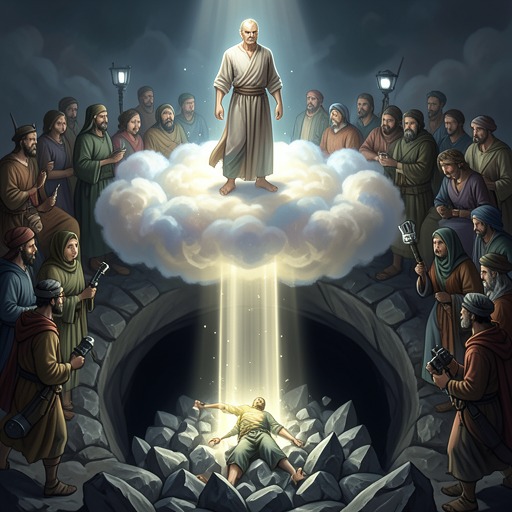
Raphael tells Adam that Satan now envies humanity because human beings occupy the state of happiness from which Satan has been excluded. Satan’s revenge is not limited to opposition against God in Heaven; he seeks to deprive Adam of blessedness and make him a companion in eternal misery. The heavenly conflict thus becomes the immediate background to the temptation in the Garden of Eden. Adam is warned that the rebels could have stood firm, but they fell through disobedience, and their example should teach him to fear transgression.
The pattern later recurs in human history. Adam’s original disobedience produces corruption in descendants who never personally touched the forbidden Tree, and Raphael shows Adam the first murder, in which Cain kills Abel after Abel’s offering receives divine acceptance. The same struggle over rightful authority appears in human politics when an ambitious ruler claims dominion over other human beings, and in the construction of the Tower of Babel, where human pride attempts to challenge Heaven. The earlier rebellion supplies the governing pattern: freedom severed from right reason becomes domination, and resistance to rightful order reproduces tyranny in another form.
The episode also stands against the later history of divine governance. God’s laws, the Mosaic Law, the Tabernacle, and the promise of Messiah present obedience not as the cancellation of freedom but as the means by which a damaged humanity may be instructed, judged, and directed toward redemption. The rebellion’s defeat does not erase conflict from creation; instead, it reveals the consequences of choosing self-exaltation over dependence on the source of being.
Narrative and Thematic Significance
As a story within Raphael’s teaching, the event performs several functions at once. It explains Satan’s identity, his motive, his followers’ fall, and the danger confronting Adam, while transforming an unseen cosmic history into an intelligible moral example. Raphael’s narration moves from heavenly ceremony to secret persuasion, from ideological dispute to single combat, and from immense warfare to expulsion, giving the episode the shape of a political crisis that becomes a cosmic judgment.
The event’s deepest reversal concerns freedom. Satan speaks as though liberation means answering to no superior, yet his rebellion ends in dependence on his own rage, his followers’ obedience to his command, and their confinement in Hell. Abdiel’s solitary loyalty appears weaker by number but proves stronger by truth. The battle consequently dramatizes a hierarchy of values: courage without wisdom becomes destruction, equality without recognition of rightful excellence becomes envy, and liberty without reason becomes another form of bondage. The rebels’ fall is not an accidental defeat but the visible consequence of their chosen separation from God and the Son of God.